

Escrow and trust accounting: how your rental income is protected
casiola property management, escrow, owner statement, property management company, vacation rental income, vacation rental trust accounting
Owner playbook
Your guests’ money is not our money. Here’s how we keep it that way.
When a guest pays for a stay in your home, that money is not income yet. It is money held on behalf of other people: you, the cleaners, the tax authorities, and only last of all your management company. Vacation rental trust accounting is the discipline of keeping those funds separate, tracked and traceable until each party is paid. It is the least glamorous part of property management and the one most likely to cost you if a manager gets it wrong.
What escrow and trust accounting actually mean
Escrow is money one party holds on behalf of another until the moment it is genuinely owed. A guest books your home in January for a stay in June. The payment arrives in January, but almost none of it belongs to anyone yet. It sits in escrow until the stay happens.
Trust accounting is the bookkeeping that sits around that money. It records who each euro or dollar belongs to, from the moment it lands until the moment it leaves. A single reservation payment usually splits into four or five directions:
- Rent that belongs to you, the owner.
- Cleaning and vendor fees that belong to the people doing the work.
- Sales and tourist taxes that belong to the state, county or municipality.
- Damage protection fees that belong to the insurer.
- Management commission that belongs to Casiola, and only once the stay is delivered.
In accounting terms, a guest deposit is a liability, not revenue. It is on our books as money we owe to someone else. That single distinction is what separates a professional operator from one that treats a busy booking season as cash flow.
Why your money needs its own bank account
Casiola runs two completely separate sets of books, with separate bank accounts behind them.
The trust books hold everything that belongs to a property: guest rent and fees, owner payments, vendor bills, utilities and taxes. The bank accounts behind them receive guest payments and nothing else.
The operating books hold Casiola’s own business: management commissions once they are earned, payroll, office costs, software and everything else it takes to run the company.
Money moves from the trust side to the operating side only when it has been earned, and it moves as a recorded transaction with a document behind it. The two never mix. This is what the industry calls avoiding commingling, and it is the single most important protection an owner has. When owner funds sit in a manager’s general account, a slow month for the manager quietly becomes a slow month for the owner. Separation makes that impossible.
2 sets of books
trust and operating, with separate bank accounts, so owner and guest funds never touch company money
How Casiola does trust accounting day to day
Trust accounting is not a month-end task. It is a daily one, because errors found a day later cost minutes and errors found a quarter later cost days. Every working day our accounting team:
- Reviews trust account deposits and matches each one to a reservation.
- Chases reservations with a missing deposit, so an unpaid stay never reaches check-in unnoticed.
- Records vendor bills and files every invoice in the correct property folder.
- Confirms each payment is approved before it leaves the account.
- Checks bank activity against the books, which is also how unusual activity gets spotted early.
Booking platforms are part of this discipline too. Payment is due at the latest by check-in, and a channel that pays late gets chased, because a payout that has not arrived is a payout we are not holding for you.

Month-end: your statement and your payout
At the close of each month the trust accounts are reconciled against the bank, line by line, before a single statement goes out. Then your statement is built in five steps:
- Accounting checks that every expense for the period is included.
- Your owner relations team reviews the reservations and expense detail on your property.
- Corrections are made before the statement is published, not after.
- The statement is finalised and published to you.
- Payment is sent to your bank account.
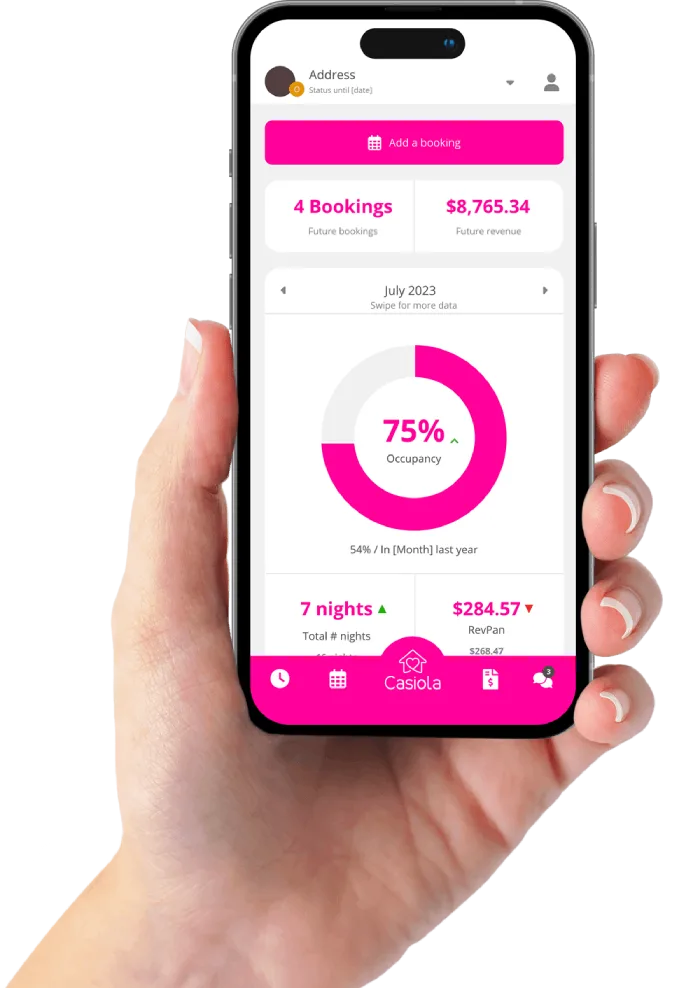
Your statement reaches you by the 10th of the month for the month before, and it shows income, expenses and upcoming reservations. Any surplus is transferred to your bank account within 10 days of the statement date. You can follow the underlying bookings in the myCasiola dashboard in real time, so the statement confirms what you already saw rather than revealing it.
If you disagree with something on a statement, raise it within 30 days. That window exists so questions get answered while the detail is fresh and the supporting documents are at hand.
By the 10th
your statement for the previous month, every month, with the payout following within 10 days
Taxes: collected, held, remitted
Tourist and sales taxes are the clearest example of why trust accounting matters. That money is collected from a guest months before it is due to a tax authority. In the meantime it is not yours and it is not ours. It is held, reported and remitted on schedule, which in many US jurisdictions means by the 20th of the following month.
Which registrations apply depends entirely on where your home is: state sales tax, county tourist tax, a business tax receipt, a city registration, an HOA requirement. Rules differ by country, by state and often by city, so the local Casiola team confirms what applies to your property and handles the filings where we are responsible for them. Nobody should be guessing at this, least of all you.
The same discipline in every market
Casiola operates in Florida, Aruba, Belgium, Costa del Sol and beyond, through local teams. The banking rules, tax authorities and currencies change from market to market. The principle does not: guest and owner funds are held separately from company funds, reconciled against the bank every month, and reported to you on a fixed date.
Belgium is the most recent proof of it. Casiola Belgium went from zero homes at the start of 2026 to roughly 150 managed homes with a full local team, and in that time the statement and the payout have gone out on the 10th every month, weekends and holidays included.
What to ask any manager before you sign
Whether or not you choose Casiola, these five questions tell you most of what you need to know about how a company handles your money:
- Do guest payments go into a separate trust account, or into your general business account?
- How often are those accounts reconciled against the bank?
- On what date does my statement arrive, and on what date does my payout arrive?
- What exactly does the statement show, and can I see the bookings behind it myself?
- Who collects and remits the taxes on my property, and what is my exposure if they are late?
A manager who answers these quickly and specifically has their house in order. One who answers vaguely is telling you something too. Good revenue management is what grows your income; sound trust accounting is what makes sure the income actually reaches you.
See exactly what your home could earn
Separate trust accounts, a statement by the 10th and a payout you never have to chase. Start with a free revenue estimate for your property: it takes about two minutes and comes with no commitment. Get your free revenue estimate

Join Casiola
